
Trump says Iran war "effectively over" but keeps US blockade
Donald Trump said talks to end the Iran war were gaining momentum after meeting Qatar's prime minister. Tehran called the claims fake news and demanded Washington accept seven conditions.
- Published in USA.
- 5 minute read.
- 2 readers have viewed this story.
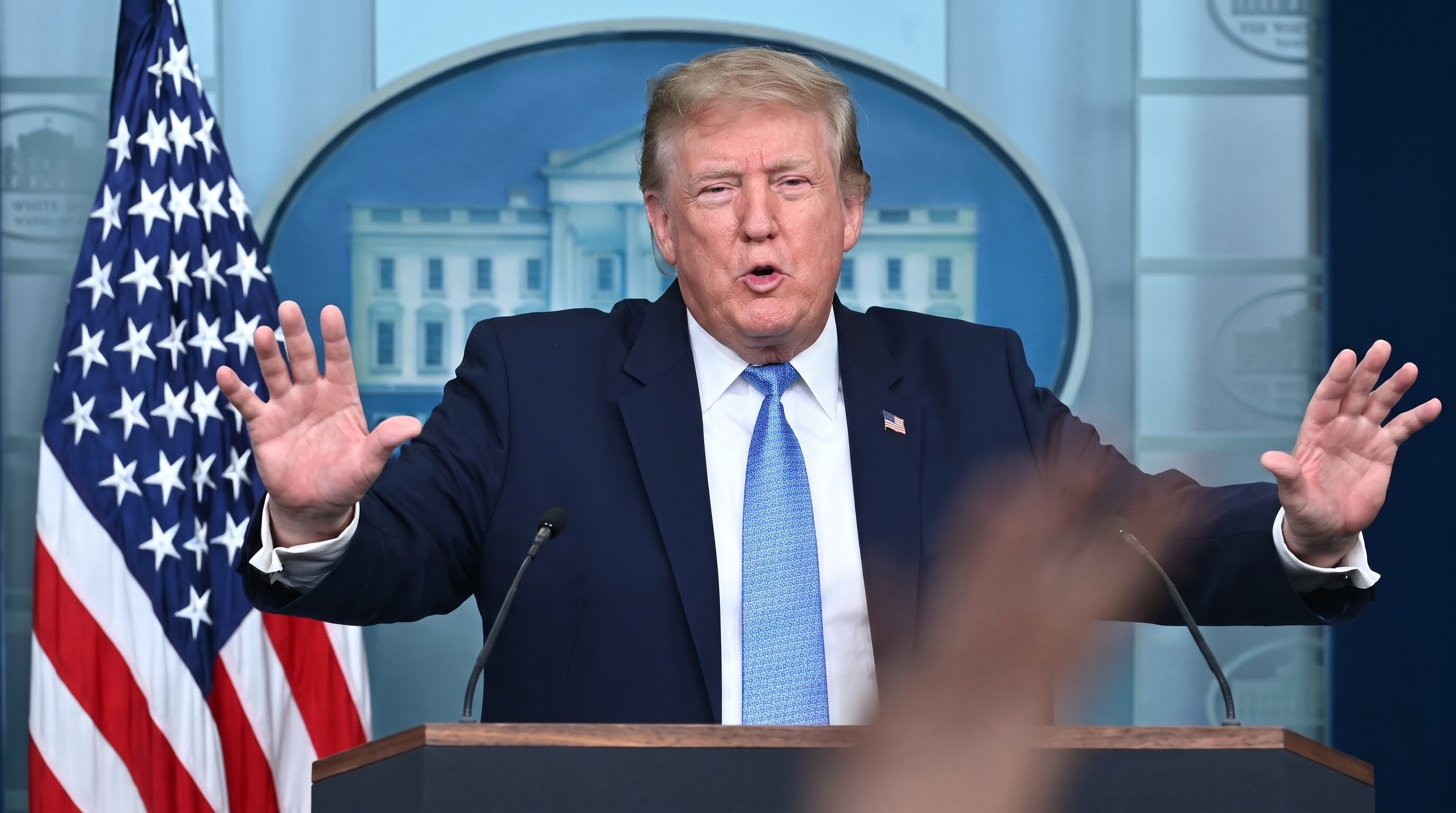
US President Donald Trump said on Monday talks to end the war on Iran were gaining momentum after he met Qatar's prime minister at the White House, while keeping a naval blockade in place.
Trump declared at a surprise briefing that "Iran militarily is effectively over," yet signalled Washington was ready to resume fighting should the need arise.
He added "We're just keeping it the status quo, and we're doing that really at the behest of countries that are their neighbours."
The status quo, Trump acknowledged, includes the US naval blockade of Iranian ports and the newly announced Task Force Iron Gate. Reuters first reported the campaign on Saturday, saying it targets Tehran's movement of advanced weapons and other sanctioned material over its land borders and through the Caspian Sea. Trump posted on Truth Social on Sunday that "Task Force Iron Gate is in full force and effect."
"Qatar, Saudi Arabia, UAE, Bahrain, Kuwait and others would prefer the status quo, that we remain as is," he said. "In other words, a continuation of the greatest naval blockade in the history of our country. Probably in the history of the world."
Trump called renewed US strikes "quite unlikely" in a Truth Social post. He told reporters "Taking military action doesn't seem to be a very necessary thing, but we're locked and loaded, ready to go for any reason that changes."
The same message came in a phone interview with CNN on Sunday. "It depends on whether or not they sign a very strong agreement," Trump said. "The answer is, highly unlikely it's going to be necessary."
He also said that if strikes resume, Washington has identified infrastructure targets, including 38 bridges "that we can knock down in literally one hour." CNN did not specify what it had asked. Both countries reported that shipping had been hit in or near the Strait of Hormuz.
Sheikh Mohammed bin Abdulrahman bin Jassim Al Thani met Trump and Vice President JD Vance behind closed doors, then wrote on X "We discussed the situation in the region and ways to progress the US-Iran talks. Grateful for the positive discussions on reaching a deal and bringing peace to the region."
Trump wrote on Truth Social "I had an excellent conversation with Sheikh Mohammed bin Abdulrahman bin Jassim Al Thani," adding that "much was discussed with respect to the Islamic Republic of Iran." Qatar is one of several mediators in the conflict, and the prime minister, who is also foreign minister, has acted as an intermediary between Washington and Tehran. He reportedly handed Trump a two-day proposal from Iran to end the war.
Tehran gave a sharply different account. Iranian officials dismissed Trump's latest remarks as a distraction, and Supreme National Security Council Secretary Mohsen Rezaei wrote on social media "The war on Iran has already wrecked the US government. But Washington flails like a desperate gambler." He told the US to "FOLD YOUR HAND. STOP manufacturing FAKE NEWS about imaginary talks."
Rezaei also said it was "time to surrender to the seven conditions Iran has repeatedly set out." Those demands include lifting US sanctions, releasing frozen Iranian funds, recognising a new shipping route through the Strait of Hormuz agreed with Oman, and ending the war on all fronts, including Israel's attacks on Lebanon.
President Masoud Pezeshkian said Supreme Leader Mojtaba Khamenei had called for an end to a situation Pezeshkian described as "neither war nor peace". Iranian media reported that he added that Iran was open to further negotiations but would not be coerced. "We will not surrender to force and bullying," he said.
The war began on February 28, and Iran almost immediately moved to shut the Strait of Hormuz, a vital waterway for oil, gas and fertiliser. Tehran also answered US and Israeli strikes with missile and drone fire on Qatar, Bahrain, Kuwait and the UAE, with many attacks aimed at US military installations.
Related conflicts have since emerged. Saudi Arabia has renewed its fight against the Iran-backed Houthis, and Israel has occupied southern Lebanon and carried out deadly air strikes there.
In the nearly nine months since the war began, the US offensive has grown sporadic, with intermittent exchanges of fire. The Trump administration recently announced "minor strikes" on Qeshm Island and offered a $20m reward for "information about Iran's nuclear program, including its facilities, equipment, and associated personnel".
Trump claimed after the Twelve-Day War in June 2025 that Iran's uranium enrichment programme had been obliterated, but he has since made curbing it a central premise of the current war. Iran has long denied seeking a nuclear weapon and says enrichment serves civilian energy generation.
The war has also reached US domestic politics. Trump acknowledged after the midterm elections that it was part of the reason for Republican defeat, while Vance, seen as a potential successor, wrote in a social media post "The reason we lost is the war."
Trump told reporters on Sunday that "a lot of people did not like Vance's comments on Iran." Secretary of State Marco Rubio, also considered a contender to succeed Trump, declined to comment on Sunday on any link between the war and the elections.
Trump said he still wanted a long-term solution on Iran's nuclear programme, and Rezaei's demand that Washington accept seven conditions leaves the two sides publicly far apart.
Comments
Join the conversation.
Have an account? Sign in to skip entering your details.
No approved comments yet.