
Is NATO Ready for What Comes Next? Ukraine Says No.
Ukrainian and Western defense officials warn that NATO's tactics and hardware risk becoming obsolete as Ukraine rewrites the rules of modern warfare in weeks, exposing deep gaps in air defense, training, and battlefield strategy.
- Published in News.
- 4 minute read.
- 7 readers have viewed this story.
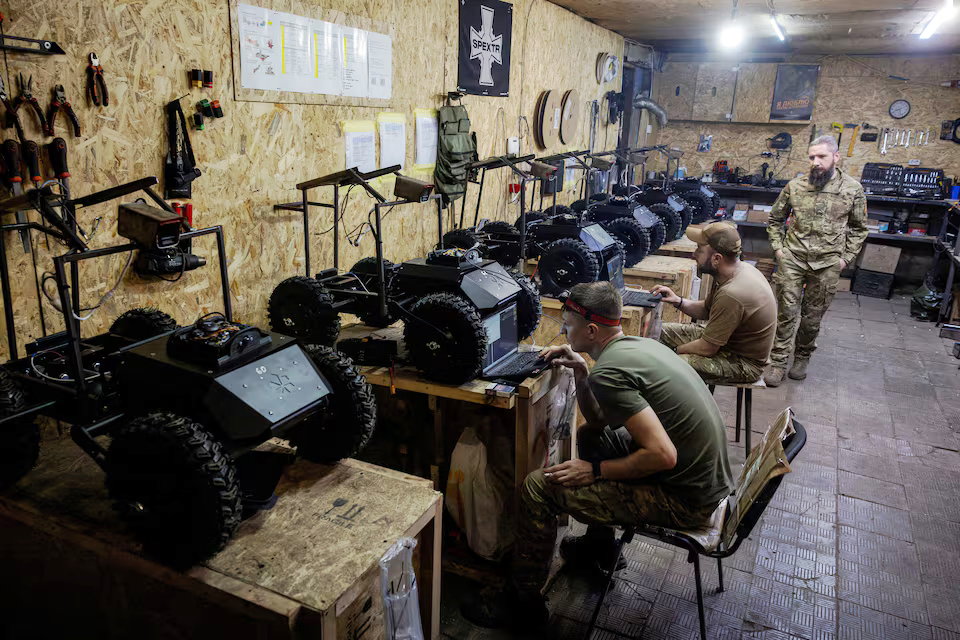
A tank costs millions. A drone that can destroy it costs about 5,000 dollars. That math, more than any single battle, is why senior Ukrainian and Western officials are quietly warning that NATO may not be prepared for the war it could eventually have to fight.
Denys Shtilerman, co-owner and chief designer of the Ukrainian missile and drone manufacturer Fire Point, has become one of the sharpest voices making that case. He argues that tanks, long treated as the backbone of any serious military, have effectively become liabilities on a modern battlefield saturated with cheap unmanned weapons. Many military analysts push back on that view, insisting armor still has a role in future conflicts, but the disagreement itself reflects a wider rift over where NATO should be spending its money.
That rift runs deeper than hardware. Five Ukrainian and Western defense officials described a battlefield evolving faster than NATO's institutions can process it. Ukraine, notably not a NATO member, rewrites its tactics in a matter of weeks. The alliance, by contrast, often takes years, sometimes decades, to field new systems, a gap officials fear is quietly rendering some Western weapons and doctrine obsolete before they're ever used.
What makes the imbalance more striking is who's now doing the teaching. Ukrainian officers increasingly describe themselves less as students of NATO and more as instructors passing along lessons the alliance has only observed from a distance. Yet those same officers say NATO's bureaucracy is slow to actually absorb what it's being shown. One Ukrainian officer who completed NATO psychological operations training in Romania told Reuters that some of the alliance's course material still drew on case studies from World War Two.
The gap shows up starkly in the sky. Russia's sustained bombardment of Ukrainian cities has exposed just how tightly Europe's air defense is tied to American hardware, particularly the Patriot system, technology that traces back to the 1991 Gulf War. Ukraine remains critically short of Patriot interceptors, and Europe, wary of leaning so heavily on a single supplier, is now moving to build its own alternatives. Ukraine is currently awaiting the French Italian SAMP/T NG system, which France has committed to accelerating, with a delivery window European diplomats have previously pegged at next spring.
A separate, homegrown push is unfolding alongside it. In July, Ukraine and nine European allies stood up an air defense coalition anchored by a new project called Freyja, an anti-ballistic missile system being developed by roughly a dozen companies with Fire Point leading the private sector side. The goal isn't just capability. It's independence, building something cheaper and faster to produce than the Patriot, manufactured entirely on European soil. Shtilerman put the logic bluntly: a country spending 20 billion dollars on its own air defense system has no business being dependent on someone else for its security.
Battlefield tactics have shifted just as sharply as the hardware. Cheap drones have made it dangerous for troops to gather in groups or move in large convoys, a lesson Oleksandr Pivnenko, Commander of Ukraine's National Guard, has tried to drill into the international troops his units trained last year. His warning was blunt. Soldiers who fail to watch the sky are soldiers who won't have a squad left.
NATO's own training exercises may be lagging behind that reality. In June, Reuters observed a NATO drill near Paldiski in Estonia, a small Baltic country now reinforcing a 210 mile border with Russia, where American and European troops practiced treating simulated casualties at wartime field hospitals. The scenario assumed NATO forces would control the airspace above those hospitals throughout, an assumption that no longer holds now that cheap, stealthy drones can strike deep behind the front line.
Budgets are starting to catch up with the warnings. The war, paired with President Donald Trump's public pressure campaign on European allies, has pushed many NATO members to sharply increase defense spending. The Pentagon is currently reassessing its own military footprint across Europe, after Trump accused allied nations of relying on U.S. protection without paying their share or supporting his campaign against Iran.
For its part, Ukraine's defense ministry has framed the relationship as a two way exchange rather than a one sided failure, crediting European partners for helping counter Russia's drone and missile bombardments while describing Ukraine's own use of drones and electronic warfare as globally unmatched. Whether that exchange moves fast enough, officials warn, may decide whether NATO is actually ready the next time it has to fight.
Comments
Join the conversation.
Have an account? Sign in to skip entering your details.
No approved comments yet.